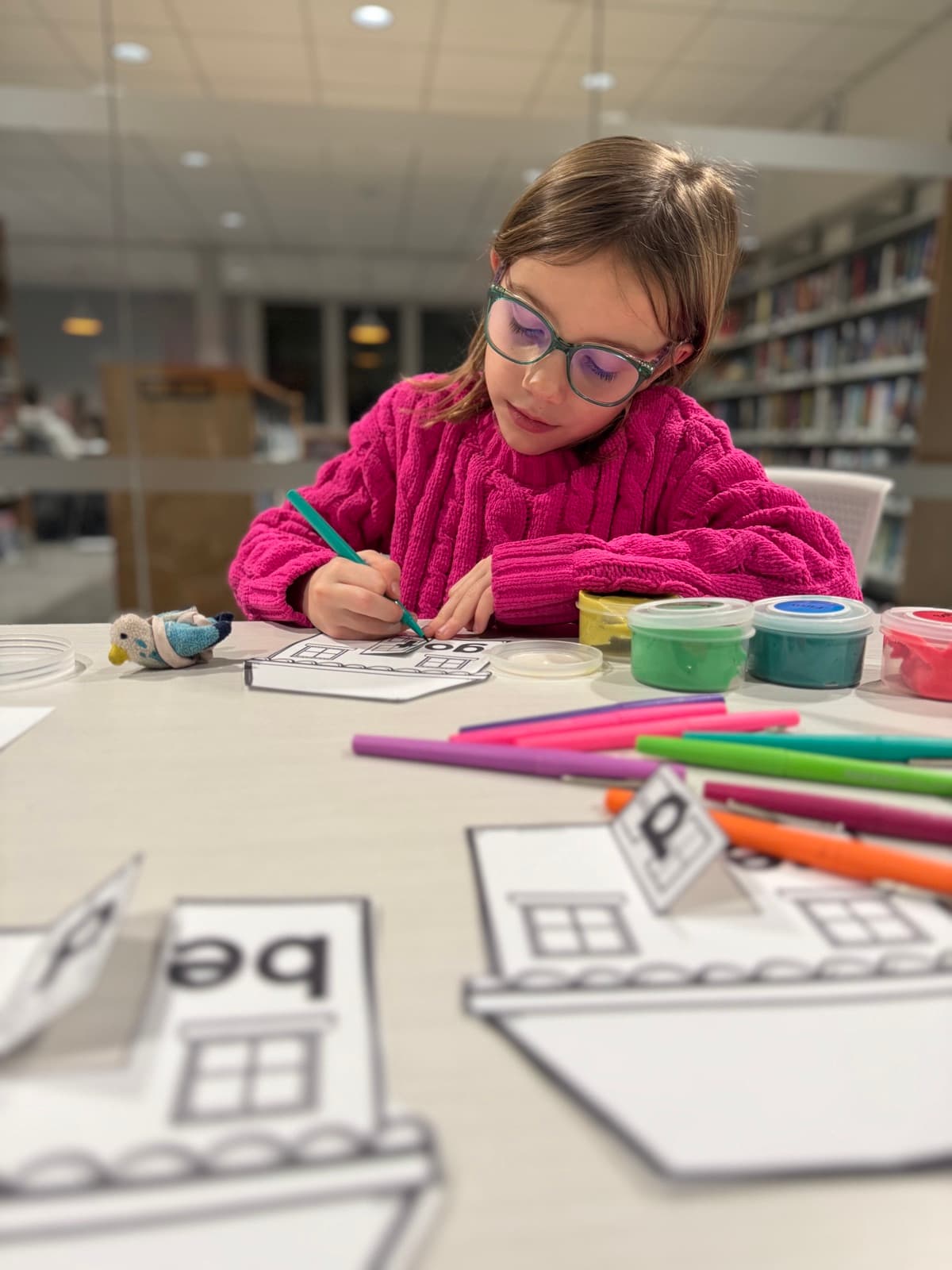
What Orton-Gillingham tutoring actually looks like
Most sites describe OG and stop there. This page is about the how — what a Tuesday at 4pm actually feels like, how long this really takes, and what your job is while your child does the work.
Orton-Gillingham, in plain English
Orton-Gillingham (OG) is a structured, multisensory, individualized approach to teaching reading, spelling, and writing to children whose brains aren't going to figure it out on their own. It was developed in the 1930s by Dr. Samuel Orton, a neuropsychiatrist studying reading failure, and Anna Gillingham, a gifted educator and psychologist. Almost a century later, it's still considered the foundation of evidence-based dyslexia instruction and most well-known structured literacy programs (Wilson, Barton, and others) are direct descendants of their work.
This is a long road
Teaching a child with dyslexia to read is not a six-week intervention. For most students, OG tutoring is a two-to-three-year commitment. Research on intensive structured literacy consistently points to that timeline, at a cadence of two sessions per week, to produce durable gains.
I tell families this on purpose, because the families who do best are the ones who walk in with realistic expectations and stay the course. Two months in, when progress feels invisible, the families who understand that this is normal don't panic. They keep going. Six months in, the breakthrough comes and it comes because they didn't quit at month two.
The first phase of this work, before any reading progress shows up, is almost always trust. Before any phonics work can land, the child has to believe that this adult isn't going to shame them, isn't going to compare them to a sibling or classmate, isn't going to give up on them. Building that trust can't be skipped or sped up. It is the foundation everything else is built on.
“The relationship is the intervention as much as the method is.”
What a session actually looks like
OG sessions are typically 45 to 60 minutes, twice a week, one-on-one. The structure is predictable — and the predictability matters, because predictability is regulating for kids who experience school as chaos.
Within that structure, what we actually do is built in real time around what your child needs that day. If they walked in dysregulated from a hard day, we adjust. If they nailed yesterday's pattern, we move forward. If they didn't, we slow down. There's no “we have to get to chapter four by next week,” because there is no chapter four. There is only your child, and where they are this Tuesday at 4pm.
Not every student needs the same intensity
The two-to-three-year, twice-a-week commitment is the right fit for most children with dyslexia. But not every student I work with is dyslexic. Some children have literacy challenges that benefit from the same structured, multisensory approach at a less-intensive cadence. This typically is once a week, with a more general literacy or learning-support focus rather than the deep dyslexia arc.
The right cadence and shape for your child is something we figure out together at the start.
Progress doesn't look like a straight line
Reading growth in dyslexic learners is not linear. It's stepwise, with long plateaus where it feels like nothing is happening, followed by sudden jumps. Illness, stress at school, a hard week at home, a growth spurt, any of these can cause temporary regression. None of them mean the work isn't working.
I track progress with regular informal assessments, share what I'm seeing openly, and adjust the plan when something isn't working. You'll always know what we're working on, what's improving, and what isn't.
The parent's job
Parents are not expected to be the tutor at home. In fact, I usually ask parents not to teach phonics on their own. Well-meaning drilling almost always confuses kids, because they end up taught two different sequences by two different people. What I will do is send home handpicked materials to support retention, but only of skills your child has already mastered with me, never new skills they're still working through. Beyond that, what parents do matters enormously, and it's mostly about protecting the conditions for the work to land:
- Show up consistently. The biggest one. The children who make the most progress are the ones whose parents protect tutoring time the way they protect a doctor's appointment.
- Keep books a place of joy. Read aloud far above their reading level. Audiobooks count. Listening while looking at the page is reading. Don't make leisure reading another arena where they have to perform.
- Use accommodations without apology. Text-to-speech, audiobooks, dictation tools, dyslexia-friendly fonts — not crutches. They're how your child accesses the world while we build the underlying skills.
- Don't weaponize tutoring. Never a punishment, never added or taken away as a consequence, never framed as “because you're behind.” It's a place where your child is met as capable.
- Stay in the loop with me. Tell me what's going on at school, what the IEP looks like, when life gets hard. The more I know, the better I can tailor what we do.
- Hold the long view when they can't. There will be weeks when your child wants to quit. Your job is to hold the bigger picture, remind them how far they've come, and trust the process. I'll do the same.
Why we talk so often
The communication loop between us is a real part of how this works. After sessions, you'll hear what we covered and what I noticed. Between sessions, I want to hear about anything that affects your child's availability for learning — illness, sleep, school stress, family changes, anxiety. Sometimes that changes the plan for our next session; sometimes it just helps me read the room when your child walks in.
Over time, this loop is how I end up supporting families well beyond the reading work itself, questions about IEP meetings, school placement, accommodations, sibling dynamics, homeschooling. That's the natural shape of a long, trusting relationship, and it's part of why I do this work.
A note on “OG-trained” vs. “OG Certified”
When you're choosing a tutor, this distinction is worth understanding, because the words sound similar and the difference is significant.
The most respected credentials come through programs accredited by the International Dyslexia Association (IDA) and the International Multisensory Structured Language Education Council (IMSLEC). These two bodies that set the bar for serious OG and structured-literacy preparation. Their programs are reviewed against the IDA Knowledge and Practice Standards for Teachers of Reading.
A practitioner who completes an accredited program goes through a defined sequence: substantive coursework (often 50+ hours), required reading, and a supervised practicum teaching real students under direct mentorship, with lessons observed and critiqued before certification is granted.
By contrast, “OG-trained” often refers to a short course. This can sometimes be a single weekend, sometimes thirty hours, but with no supervised practicum, no observations, and no application process. Both kinds of practitioners can legitimately say they use the Orton-Gillingham approach. The depth of preparation underneath the label is very different.
Who this is for
- ✓Children K–8 — the heart of my practice, and where I do my deepest work.
- ✓Younger learners (Pre-K) and older learners (high school, occasionally adults), welcomed case-by-case.
- ✓Children with diagnosed dyslexia or a dyslexic profile, at the intensive multi-year cadence.
- ✓Children with literacy challenges who aren't dyslexic but benefit from structured, multisensory instruction — usually a lighter cadence.
- ✓Children who've been through school reading intervention without enough progress.
- ✓Children whose decoding, spelling, or fluency is significantly behind, regardless of label.
Curious whether OG is right for your child?
The first conversation is free. Tell me a little about your reader and where things stand, and we'll figure out the right shape together.
Schedule a consultation call